Which of the Following Statements Is True of Restriction Enzymes
Which of the following statements does not hold true for restriction enzyme. NCERT DC Pandey Sunil Batra HC Verma.

Action Of Restriction Enzyme Dna Technology Recombinant Dna Biology Notes
They are made by bacteria and viruses.

. Enzymes increase the rate of a reaction by lowering the activation energy barrier. It produces the same kind of sticky ends in different DNA molecules. The plasmid will contain the human gene.
No restriction enzyme is isolated from viruses. Which of the following statements does not hold true for restriction enzyme. They are used in genetic engineering techniques to isolate specific segments of DNA.
More than 900 restriction enzymes have been isolated from over 230 strains of bacteria each of which recognise different recognition sequences. Which of the following statements not true for restriction enzyme which is used in genetic engineering. It recognises a palindronic nucleotide B.
They produce single-stranded complementary ends that can join to two different DNA strands by complementary base pairing. The bacterial DNA will not be cut open by the restriction enzyme. A Most restriction enzymes recognize sequences of 20-25 bp in length.
Which of the following statements about enzymes is false. It is isolated from bacteriophages D. The plasmid will not contain the human gene.
Which of the following statements regarding enzymes is true. Correct option is A Restriction enzymes cut DNA strands by identifying specific sequences of nucleotides. The restriction enzymes or restriction endonuclease are called molecular scissors and they are responsible for cutting DNA on specific sites.
They are made by bacteria and viruses. It recognises a palindromic nucleotids sequence. The correct answer was given.
It produces the same kind of sticky ends in different DNA molecules. All of the following statements are true about restriction enzymes EXCEPT A. They can be found in bacteria which provide a type of defence mechanism called the restriction modification system and the so-called process consists of two component restriction enzymes and modification enzymes.
Restriction enzymes are enzymes which have the ability to recognize and cut a particular sequence of DNA. D Restriction enzymes may produce either sticky or blunt ends when digesting host DNA. Most restriction enzymes recognize sequences of 20-25 bp in length.
Restriction enzymes cut both strands of the double-stranded DNA molecule. These enzymes are isolated from prokaryotic bacterial cells. Which of the following statements regarding enzymes is not true.
It recognises a palindromic nucleotide sequence D. Restriction enzymes recognize specific sequences on DNA and always cuts so that only blunt ends are produced. It is isolated from viruses C.
Sequences of DNA that are recognized by restriction enzymes are called recognition or restriction sites are usually are between 4 and 8 bases long. Hundreds of different ones have been isolated and purified. These are obtained from bacteria Example EcoRI.
It is isolated from viruses. Which Of The Following Statements Regarding Enzymes Is True. Restriction enzymes naturally occur in many species of bacteria as.
All of the following statements are true about restriction enzymes EXCEPT. QUESTION 4 Which of the following statements is true. B hundreds of different ones have been isolated and purified.
It is an endonuclease. They are made by only bacteria not viruses. C All restriction enzymes make blunt ends at their recognition sites.
Restriction enzymes break phosphodiester bonds between nucleotides. Select all that apply. It can be used at higher temperatures.
It is more efficient to anneal. B A given restriction enzyme always recognizes the same DNA sequence but will cut differently depending on the species of origin of the DNA. Enzymes increase the rate of a reaction by reducing the rate of reverse reactions.
C Most restriction enzymes recognize palindromic sequences in host DNA. These enzymes recognizes a palindromic sequence of nucleotide ie a sequence which makes the same word when read forward and backward. It produces sticky ends.
In the bacterial cell restriction enzymes cleave foreign DNA thus eliminating infecting organisms. All restriction enzymes bind to the same palindromic DNA sequence. Which of the following statements does not hold true for restriction enzyme.
No restriction enzyme is isolated from viruses. B Bacteria can add methyl groups to their DNA to prevent digestion by endogenous restriction enzymes. The bacteria will be unable to host the plasmid.
A A given restriction enzyme always recognizes the same DNA sequence and will cut identically regardless of the species of origin of the DNA. Which of the following statements about restriction enzymes are true. Hundreds of different ones have been isolated and purified.
Which of the following statements does not hold true for restriction enzyme. Restriction enzymes can be used to compare different genomes based on the produced pattern of DNA fragments. They produce single-stranded complementary ends that can join to two different DNA strands by complementary base pairing.
Correct option is C Restriction enzymes are endonucleases that cleave phosphodiester bonds in the DNA backbone. C they produce single-stranded complementary ends that can join to two different DNA strands by complementary base-pairing. It is an endonuclease C.
All of the following statements are true about restriction enzymes EXCEPT A they are made by bacteria and viruses. Restriction enzymes cut DNA randomly. It is an endonuclease B.
It produce the same kind of stickly ends in different DNA molecules. The restriction enzyme will be unable to cut the human DNA. Restriction enzymes that perform staggered cuts are more important for the application of recombinant DNA technology compared to restriction enzymes that perform straight cuts because.

Pin By Noble On دبلومة كيمياء حيوي Biology Worksheet Biotechnology Molecular Biology

Restriction Enzymes Science Biology Teaching Biology Biology Labs
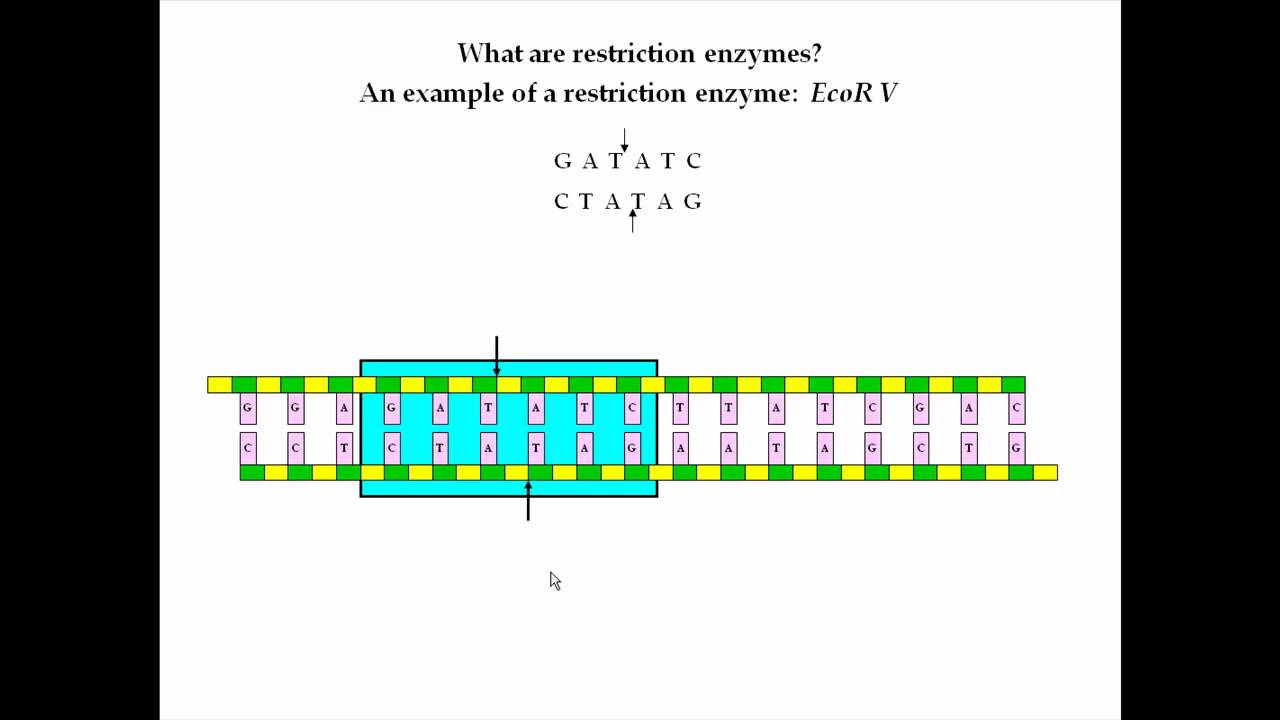
Restriction Enzymes Pt 1 Enzymes Dna Physiology
Understanding Restriction Enzymes Is A Self Guided Study Of Restriction Endonucleases Dna Scissors That Leads S Classroom Instruction Enzymes Understanding

Pin On Cours

Pin On Simple Biology Videos

Pin On Dna

Understanding Restriction Enzymes Classroom Instruction Understanding High School Biology

Biology Exams 4 U Dna Technology Recombinant Dna Biology

Pin On Dna

Biorender Dna Ligase Knowledge Is Power Knowledge

ป กพ นในบอร ด Mcat

How The Mark Of The Beast Will Rewrite The Human Genome Part Three Corrupting The Image Human Genome Genome Recombinant Dna

Examples Of Type Ii Restriction Enzyme Dna Technology Essay Recombinant Dna

Pin On Dna

Recombinant Dna Fundamentals Of Biology Biology Biology Recombinant Dna Teaching Biology

Restriction Enzymes A Genetic Engineering Restriction Endonuclease Activity In 2021 Science Teaching Resources Secondary School Science Middle School Science Teacher

Restriction Enzymes A Genetic Engineering Restriction Endonuclease Activity Middle School Science Teacher High School Science Science Teaching Resources

Biotech Research And Development Biotechnology Genetic Information Recombinant Dna


Comments
Post a Comment